
Aircon chemical cleaning, explained
“Chemical cleaning” is two different jobs sold under similar names. A chemical wash is done with the unit still on the wall. A chemical overhaul takes the unit down and apart. Both use a cleaning chemical, because the dirt they are after is stuck on too hard for water and a brush.
Which one a unit needs depends on where the dirt is. This guide covers what each method reaches, how to tell which your unit needs, and what it costs.
Written by Wilson Lee, owner and lead technician at LM Brothers Aircond · 10 years in the trade · Reviewed 16 November 2026
Why an aircon needs chemical cleaning at all
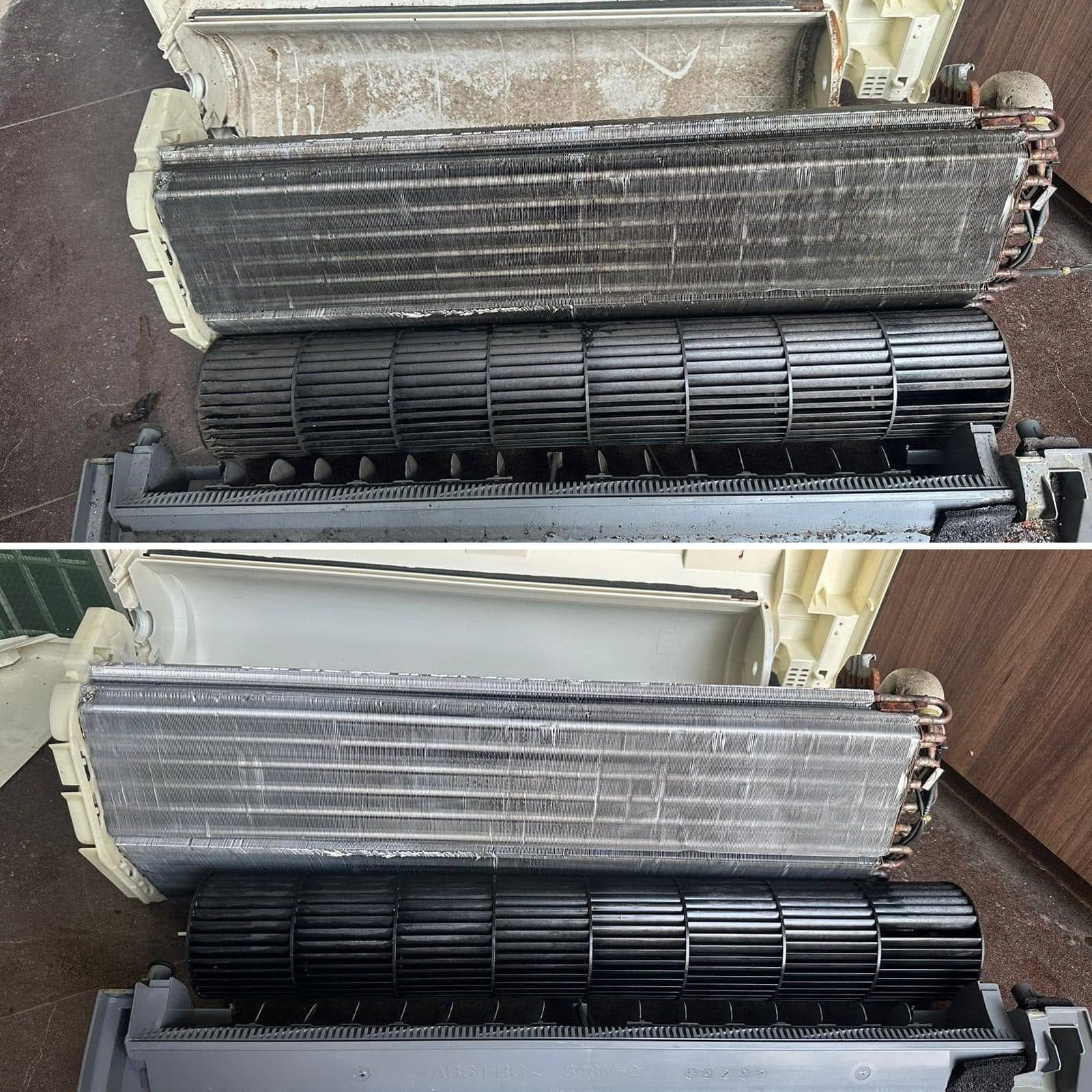
An aircon’s indoor coil is wet whenever it is cooling: that is how it pulls moisture out of the room. Any dust that gets past the filter lands on wet metal and sticks. In Singapore’s humidity, mould grows into that layer, and over months it sets into a film between the fins that water runs straight past.
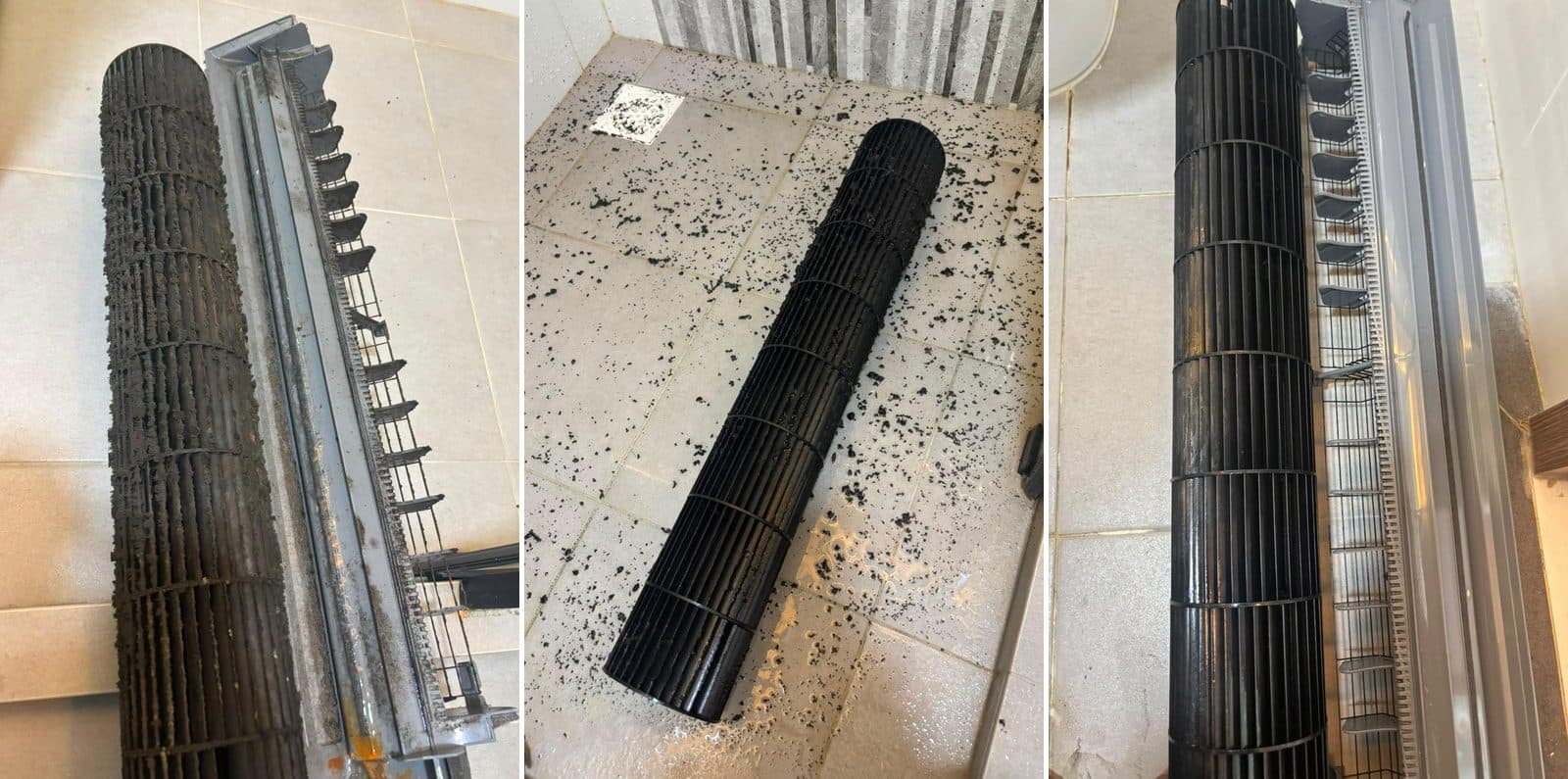
The same thing happens to the blower wheel, the drum of thin blades that pushes air into the room. Its blades pack with grime until the gaps between them close up. Then the unit moves less air, cools more slowly, starts to smell, and the tray underneath silts up and overflows.
Servicing, chemical wash and chemical overhaul side by side
- What happens
- Filters and front cover washed, blower wheel brushed where the model allows, drain line vacuumed, water tray cleared. Water and a brush, no chemical.
- What it reaches
- Everything you can see with the cover off.
- When
- Every three months, on a unit that is still cooling well.
- Cost
- $50 for one unit at LM
Chemical wash
- What happens
- The unit stays on the wall. The electronics are covered, the coil is sprayed with a coil cleaner, left to work, then rinsed with a pressure sprayer into a catch bag.
- What it reaches
- The front face of the coil and the parts of the blower wheel the spray can get to.
- When
- Sold as the step between a service and an overhaul.
- Cost
- Not offered by LM
- What happens
- The unit comes off the wall and is fully dismantled. Coil, blower wheel, casing and drainage tray are each treated with chemical and flushed.
- What it reaches
- Every surface of every part, including the back of the coil and the inside of the blower wheel.
- When
- About once a year, or when servicing has stopped bringing the cooling back.
- Cost
- $130 first unit, $88 each after
| What happens | What it reaches | When | Cost | |
|---|---|---|---|---|
| General servicing | Filters and front cover washed, blower wheel brushed where the model allows, drain line vacuumed, water tray cleared. Water and a brush, no chemical. | Everything you can see with the cover off. | Every three months, on a unit that is still cooling well. | $50 for one unit at LM |
| Chemical wash | The unit stays on the wall. The electronics are covered, the coil is sprayed with a coil cleaner, left to work, then rinsed with a pressure sprayer into a catch bag. | The front face of the coil and the parts of the blower wheel the spray can get to. | Sold as the step between a service and an overhaul. | Not offered by LM |
| Chemical overhaul | The unit comes off the wall and is fully dismantled. Coil, blower wheel, casing and drainage tray are each treated with chemical and flushed. | Every surface of every part, including the back of the coil and the inside of the blower wheel. | About once a year, or when servicing has stopped bringing the cooling back. | $130 first unit, $88 each after |
What a chemical wash can and cannot do
- What it does well
- Done properly, a wash shifts far more than a general service. The chemical breaks down the film on the front of the coil, and the rinse carries it away. On a unit that is only moderately dirty, the difference in airflow and smell can be real.
- Where it falls short
- The spray and the rinse only reach what faces them. The back of the coil, the inner edges of the blower blades and the underside of the tray stay where they were. Some of the loosened dirt also runs down into the tray and drain line, which is the part most likely to cause a leak later.
- Why LM does not offer it
- When a unit needs more than a general service, the dirt is usually in the places a wash cannot reach. So when a service is not enough, we take the unit apart rather than sell a halfway clean.
- What to ask if you book one elsewhere
- Whether the blower wheel comes out or is sprayed in place, how the electronics are protected, and how the drain line is cleared afterwards. Those three answers tell you most of what you are paying for.
What happens in a chemical overhaul
- The indoor unit comes off the wall.
- It is taken apart: casing, coil, blower wheel, drainage tray and fan motor.
- Each part is treated with chemical, left to work, and flushed clean.
- The drain line is cleared end to end while everything is open.
- The unit is reassembled, remounted, and run until it is cooling properly.
Because every part is in a technician’s hands, it is also the best moment to spot a worn fan bearing or a corroded tray before it fails. See the chemical overhaul service.
Which one does your unit need?
- A general service is enough if
- The unit is serviced every three months or so, still gets the room cold, and does not smell. Chemical cleaning on a unit like this is money spent too early.
- An overhaul is due if
- It has been a year or more since any cleaning, or the unit has never been overhauled and is more than a year old.
- An overhaul is overdue if
- A general service last month did not bring the cooling back, a musty smell returns within days of a clean, or you can see black specks on the blower wheel through the louvres.
- Cleaning will not help if
- The unit is low on gas, blinking an error, tripping the breaker or not starting. Those need diagnosing: aircon repair or gas leak repair.
Can you chemical-clean an aircon yourself?
Foaming coil-cleaner sprays are sold for home use. Sprayed on the front of the coil they can lift some surface grime, but there is no way to rinse a wall-mounted unit properly at home. The foam and the dirt it loosens drain into a tray and pipe that are often already half blocked, which is a common way to turn a smelly unit into a leaking one.
What is worth doing yourself is the filter. Slide it out, rinse it under the tap every two to four weeks, and let it dry before putting it back. It keeps more dust off the coil than anything else you can do, and it costs nothing. Leave the chemicals and the electronics to a technician.
Common questions
- How often does an aircon need chemical cleaning?
- About once a year for a unit in daily use in Singapore, with general servicing every three months in between. A unit that is serviced regularly can go longer. One that has gone a year or more without any cleaning usually needs it straight away.
- Is a chemical wash the same as a chemical overhaul?
- No. A chemical wash cleans the unit with chemical while it stays on the wall. A chemical overhaul takes it off the wall and apart, so every part is cleaned on every side. An overhaul costs more and takes longer, and reaches the dirt a wash cannot.
- How much does aircon chemical cleaning cost in Singapore?
- At LM, a chemical overhaul is $130 for the first unit and $88 for each unit after, with no GST added. A chemical wash, where it is offered, is usually priced between a general service and an overhaul. Ceiling cassettes are quoted separately because the unit has to come down from the ceiling.
- How long does a chemical overhaul take?
- Around an hour per wall-mounted unit, sometimes longer on a ceiling cassette or a unit that is badly clogged. It is slower than a service because the unit is fully taken apart and put back together.
- Will chemical cleaning fix an aircon that is not cold?
- If the cause is a coil and blower wheel clogged with grime, yes, and that is the most common cause. If the unit is low on refrigerant, or a part has failed, no amount of cleaning will help. If a unit is still weak after a proper clean, it needs diagnosing rather than another clean.
- Will chemical cleaning stop my aircon leaking water?
- Often. Most leaks come from a drainage tray and drain line silted up with the same grime that coats the coil, and an overhaul clears both end to end. It will not fix a cracked drain pipe or a unit that has tilted on its bracket; those are repairs.
- Is the chemical safe to use in a bedroom?
- Yes, when it is rinsed off properly. The cleaning is done on the parts, not in the air you breathe, and a properly rinsed unit should not smell of anything once it is running again. A chemical smell that lasts more than a day means it was not rinsed well enough.
Not sure which one your unit needs?
Tell us how old the unit is, when it was last cleaned and what it is doing. We will tell you whether a general service will do, before anyone comes out.