
What BTU aircon do you need? A room-by-room guide
BTU is how much heat an aircon can take out of a room in an hour. Most home units in Singapore come in four sizes: 9,000, 12,000, 18,000 and 24,000 BTU.
A good starting point is about 600 BTU for every square metre of floor. Measure the room, multiply, and round up to the next size. Then adjust for sun, roof heat and anything that makes the room hotter than average.
Written by Wilson Lee, owner and lead technician at LM Brothers Aircond · 10 years in the trade · Reviewed 16 November 2026
Aircon size by room
9,000 BTU2.6 kW · 1 hp
Up to about 15 sqm
Common bedrooms, and most HDB master bedrooms
12,000 BTU3.5 kW · 1.5 hp
About 15–20 sqm
Large master bedrooms, or a smaller room with strong afternoon sun
18,000 BTU5.3 kW · 2 hp
About 20–30 sqm
Living rooms in most HDB flats, condo living-dining areas
24,000 BTU7.0 kW · 2.5 hp
About 30–40 sqm
Large or open-plan living and dining, older HDB flats with big living rooms
| BTU | kW | Shops call it | Room size | Usually fits |
|---|---|---|---|---|
| 9,000 | 2.6 | 1 hp | Up to about 15 sqm | Common bedrooms, and most HDB master bedrooms |
| 12,000 | 3.5 | 1.5 hp | About 15–20 sqm | Large master bedrooms, or a smaller room with strong afternoon sun |
| 18,000 | 5.3 | 2 hp | About 20–30 sqm | Living rooms in most HDB flats, condo living-dining areas |
| 24,000 | 7.0 | 2.5 hp | About 30–40 sqm | Large or open-plan living and dining, older HDB flats with big living rooms |
Room sizes assume a normal ceiling of about 2.6–2.8 m and no strong afternoon sun. For anything else, see the adjustments below.
Working it out for your room
- Measure the length and width of the room in metres and multiply them for the area.
- Multiply the area by 600.
- Round up to the next standard size: 9,000, 12,000, 18,000 or 24,000.
- If any of the adjustments below apply and you are close to the line, go up one size.
Example: a common bedroom. 3.3 m by 3.0 m is 9.9 sqm. Times 600 is about 5,900 BTU, so the smallest standard size, 9,000 BTU, covers it with room to spare.
Example: a living room. 6 m by 4.5 m is 27 sqm. Times 600 is about 16,200 BTU, which rounds up to 18,000. If that living room faces west and opens onto the kitchen, 24,000 is the safer choice.
When to size up
- West-facing, or big windows
- Afternoon sun through glass is the biggest extra load in a Singapore home. A west-facing room can need 10 to 20 percent more than its floor area suggests.
- Top floor
- The roof slab soaks up heat all day and gives it back into the room below well into the evening.
- Open to the kitchen
- Cooking adds heat and steam, and the aircon is cooling the kitchen too. Count the kitchen in the floor area if there is no wall or door between them.
- High ceilings, or a busy room
- Above about 2.8 m there is more air to cool. A home office with a gaming PC or several screens, or a room that regularly holds more than two or three people, also runs hotter.
Typical sizes in an HDB flat
- Common bedrooms are usually around 9 to 10 sqm: 9,000 BTU.
- Master bedrooms are usually around 11 to 13 sqm: 9,000 BTU, or 12,000 if the room is west-facing or on the top floor.
- Living and dining areas run from about 20 sqm in newer flats to well over 30 sqm in older ones: 18,000 BTU, or 24,000 for the larger and open-plan layouts.
Rooms vary a lot between flat types and building years, so measure yours rather than relying on the flat type.
Why a bigger aircon is not better
- Too big: cold but clammy
- An oversized unit cools the air fast and reaches the set temperature before it has pulled the moisture out. The room feels cold and damp. It also switches on and off more often, which wears it faster, and it cost more to buy.
- Too small: never quite cold
- An undersized unit runs flat out through the afternoon and still does not reach the set temperature. It costs more to run than the right size would, and it shortens the compressor’s life.
- Inverters soften the difference
- An inverter unit slows down instead of switching off, so a slightly large one copes better than an old on-off unit would. It still cannot run below its minimum speed, so a unit far too big for the room has the same problem.
- Efficiency matters as much as size
- Singapore’s energy label rates aircons from one to five ticks. For a bedroom aircon that runs every night, a higher-tick inverter model usually pays back its higher price in lower bills.
Multi-split systems: System 2, 3 and 4
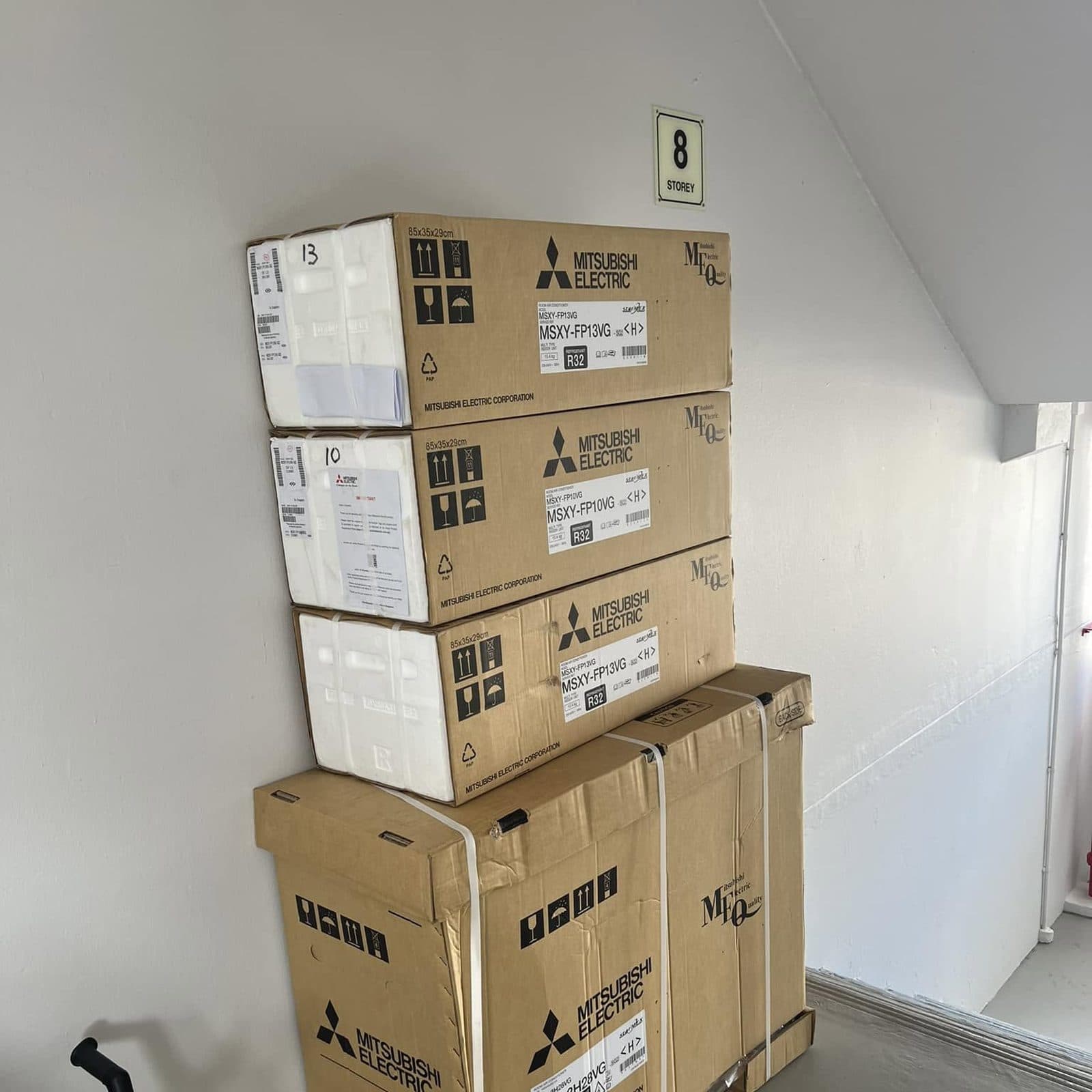
In most HDB flats and condos, one outdoor condenser on the aircon ledge runs two to four indoor units. Choose each indoor unit for its own room using the table above. The condenser is then matched to that combination from the manufacturer’s tables. That is the installer’s job, not something to work out from the room sizes.
Getting the size right matters less if the installation is poor. A long pipe run, badly made joints or a skipped vacuum will cost more cooling than choosing one size up or down. How we install.
Common questions
- Is 9,000 BTU enough for a master bedroom?
- In most HDB flats, yes. Master bedrooms are usually around 11 to 13 sqm, which a 9,000 BTU unit cools comfortably. Go to 12,000 BTU if the room is larger than about 15 sqm, faces west with big windows, or is on the top floor.
- What does a 1 hp aircon mean?
- It is the shop label for roughly 9,000 BTU, with 1.5 hp for about 12,000 and 2 hp for about 18,000. It is not a precise measurement and brands use it loosely, so compare the BTU or kW figure on the spec sheet instead.
- Can one aircon cool both the living and dining area?
- Yes, if they are one open space. Add the two areas together and size for the total, which usually means 18,000 or 24,000 BTU. An L-shaped layout, or a dining area round a corner from the unit, may need two smaller units instead, because cold air does not turn corners well.
- Does a bigger BTU aircon use more electricity?
- A bigger unit draws more power when running flat out, but a correctly sized inverter unit is the cheapest to run overall. An undersized unit runs at full power all afternoon trying to keep up. An oversized one switches on and off more and does a worse job of drying the air.
- How do I find the BTU of my current aircon?
- Check the rating label on the side of the indoor unit, which gives the cooling capacity in kW or BTU/h. Many model numbers include it too: a "25" in the model often means 2.5 kW, roughly 9,000 BTU. If the label is gone, send us a photo of the unit and we can usually tell you.
- What is a System 4 aircon?
- One outdoor condenser running four indoor units, usually three bedrooms and the living room. A common setup in a 4-room HDB flat is three 9,000 BTU bedroom units with an 18,000 or 24,000 BTU unit in the living room. The condenser is matched to that combination from the manufacturer’s tables.
Send us your rooms and we will size them
Message the room sizes, or photos with rough measurements, and which way the windows face. We will recommend the sizes and quote the installation before anyone comes out.